
Navigating ethical and moral challenges of youth sports organizers-On and off the field
There are innumerable judgment calls to be made in running a young sports club or league that have nothing to do with victories and losses. If a failing player gets extra playing time to build confidence, even if it costs the team a game? Is it OK to put a coach's kid on the team over a better player? Who selects which families get financial aid, and who safeguards athletes when something goes wrong away from the field altogether?
These are ethical concerns, not administrative ones, and youth sports administrators are faced with them at every turn: on the field at games and practices, and off the field in board meetings, registration systems and parent group texts. This guide outlines the most typical ethical and moral dilemmas that organizers confront, organized by where they actually happen, and provides a practical framework for those instances that don't have an obvious right response.
Key Takeaways
-
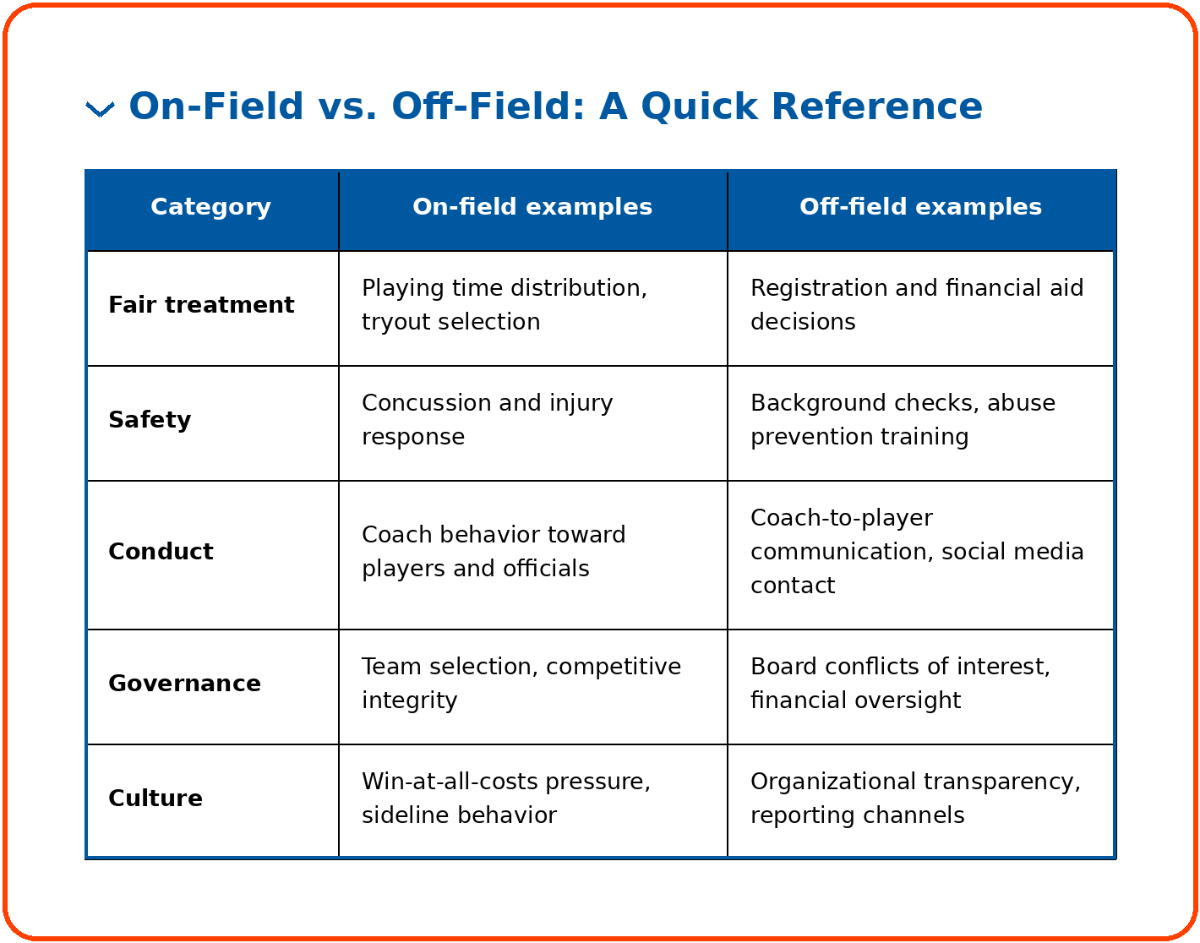
Youth sports ethics can be divided into two related areas: decisions made on the field (playing time, coaching behavior, competitive culture) and decisions made off the field (government, financing, safeguarding, communication, data privacy).
-
That is the whole idea of having formal safeguards like background screening, written codes of behavior, and reporting procedures: they decrease the number of judgment calls organizers have to make in the moment.
-
Favoritism and pay-to-play obstacles are among the most frequent complaints from families involved in young sports, and both are best handled with transparent written policies than with case-by-case choices.
-
Having a written reporting process protects athletes and the organization alike and needs to be in place before an incident occurs not after.
-
Technology cannot make ethical decisions for a company, but it may offer the consistency and paper trail that make those decisions easier to explain and defend later.
What Does "Ethics" Mean for a Youth Sports Organization?
In adult professional sports the players are adults, they are paid and they have made a choice about the level of risk and pressure they are under. In child sports it is nothing like that. The stakes weren’t decided by the kids, the parents are footing the bill to be there and most of the adults running the show are volunteers with little to no expertise in governance, child protection or dispute resolution.
That mix ups the ante. The ethical obligation of an organization is far more than “don’t cheat” or “be nice to the kids”. It discusses how decisions are made, who makes them, if they are consistent from family to family and whether the organization has really prepared for the events it hopes never occur.
What Ethical Challenges Show Up On the Field?
Playing Time and Fair Selection
The most common complaint in child sports isn’t abuse or cheating. It’s time to play. Parents sometimes wonder why their youngster sat, but coaches often answer with a gut feeling rather than a set policy.
The cure isn’t getting rid of competitive judging, it’s putting the policy in writing before the season starts. Recreational and developmental age groups usually need a minimum playing time rule in writing. Competitive and travel teams can still be merit oriented but the selection criteria (attendance, tryout scores, position needs) should be documented and applied equally to every player including the coach's own kid. Usually a decision that should have had a policy in the first place is any decision that can’t be consistently explained to any parent that asks.
Coaching Conduct and the Win-at-All-Costs Problem
Adults to kids: Pressure to win trickles down swiftly. Running up the score against a weaker team, leaving an injured player in the game because it's close, or chewing out a nine-year-old for a missed shot like a pro coach would a pro.
Organizations that do this properly tend to clearly distinguish development-level programs from competitive ones, train coaches on age-appropriate expectations and provide coaches with a private channel for correction without public disgrace. The idea is not to take the competitive aspect out of child sports. It’s to make sure the kids’ stake in having a nice experience doesn’t become lost in the adults’ stake in winning.
How Coaches and Organizations Treat Officials
There is a proven scarcity of officials in youth sports, and groups that track sports officiating, including the National Association of Sports Officials, have said abusive behavior from coaches and parents is one of the top reasons officials leave the field. When a teenage ref has no consequence for yelling at him, the good officials quit coming up, and the games go worse for everyone, including the players the abuse was allegedly protecting.
The most immediate remedy available to a single organization is a written code of behavior for both coaches and spectators, with a clear and enforced punishment (warning, then suspension).
What Ethical Challenges Show Up Off the Field?
Governance and Conflicts of Interest
The same dilemma arises with board members who have children playing on certain teams, vendors who have personal relationships with leadership, and coaches who also participate on the disciplinary committee: a judgment that is difficult to trust even when it is the right one. The fix is procedural, not personal.” Create a recusal policy that requires anyone with a direct stake in a choice to step out of the room for that decision. Document who made each call.
Pay-to-Play and Access
The cost of competitive youth sports, especially travel and select programs, has become so high it’s a leading cause of youngsters quitting or not even playing in the first place. This is not only a matter of justice, it is an issue of who gets to play the sport.
The ones that really care will often provide a clear pricing schedule up front (no unexpected expenses mid-season), have a scholarship or financial assistance fund with a simple application process, and accept monthly payments instead of requesting one flat sum. None of this demands charging less overall, it just charging reliably and providing a viable avenue for families that cannot pay all at once.
Safeguarding and Background Screening
This is the area with the least opportunity for judgment decisions, because the norms are already in place. Regular volunteers and coaches should have background checks, and these should be on a predetermined timetable, not just a one-time box to check at onboarding. The most simple and effective precautions available cost nothing to put in place. One is the "two-deep" rule, that is, no coach or volunteer should ever be alone with one youngster without another adult present. U.S. organizations are increasingly adopting the U.S. Center for SafeSport’s training standards even for non-Olympic-affiliated sports since the training is about spotting and reporting abuse, not simply avoiding it personally.
Mandatory reporting rules differ from state to state and country to country, but the general expectation is the same everyplace: Organizers who suspect abuse are supposed to disclose it to the relevant government, rather than to manage it internally.
Communication and Social Media Boundaries
One of the more preventable danger areas in kid sports is direct, private communications between an adult coach and a minor player in a channel that the parent can’t see. Those who do this well have all team contact through group channels that include parents, or a platform where messages are logged and viewable to more than one adult. This isn’t thinking that every coach is out to get you. It is about getting rid of the private place where, if there is a problem, it can go undiscovered.
Data Privacy for Minors
Registration systems gather an enormous quantity of sensitive data about children: medical issues, birth dates, home addresses, emergency contacts, sometimes insurance information. That data needs limited access (not every volunteer needs to know every player’s medical history), safe storage and a set retention strategy so old records don’t linger around indefinitely. Organizations operating in or servicing families in the U.S. should also be aware of children’s data protection legislation like COPPA when collecting information from users under age 13.
The Ethical Decision Checklist for Youth Sports Organizers
Not every situation can be properly categorized in a written policy. When organizers are in a real gray area, these six questions assist explain the decision before it’s made:
-
Is this a decision based on a written policy, or one person's decision in the moment?
-
Would I be comfortable expressing this decision to each family affected?
-
Does this decision treat players and families equally?
-
Who else evaluates this choice, or is there an appeal if someone does not agree?
-
Does this decision safeguard the most vulnerable party in the situation? Often the child?
-
If this decision is challenged six months down the line, is there a paper trail of how and why it was made?
if the honest response to more than one of them is a "no," that's a clue the decision needs another set of eyes before it becomes definitive, not after.
Common Mistakes Youth Sports Organizations Make
-
Making judgments about family money or a child’s safety based on unwritten norms or gentlemen’s agreements.
-
Viewing background checks as a one-off, at-onboarding process rather than a continuing obligation.
-
One board member or head coach making crucial decisions without a second reviewer.
-
Developing a reporting mechanism when a complaint occurs instead than having it in place already.
-
Different teams within the same organization communicate regulations inconsistently, so one team's rules are another team's rules.
How Documentation and Technology Support Ethical Consistency
None of the above requires a new technology fix. Most would be handled by a common spreadsheet and a rigid practice of writing things down. But in fact, it's impossible for businesses with many teams and hundreds of families to manually maintain regulations, background check records and communication logs consistent.
This is where a centralized platform like SportsPlus can help—not by making ethical decisions for the organization, but by making the organization’s own policies easier to apply the same way every time: registration forms that collect the same information from every family, a place to store and distribute the code of conduct so every parent and coach has actually seen it, and communication tools that keep coach-to-team messages visible rather than private. The calls still belong to the folks who operate the organization. The infrastructure only makes it easier to make those choices regularly, and easier to defend down the road.
Final Word
Most ethical lapses in juvenile sports are not caused by terrible people. They are the result of excellent individuals making contradictory decisions in the moment, since there was no policy to guide them. The organizations that do this well are not the ones with the harshest regulations; they are the ones that set the rules down before they needed them, applied them the same way to every family, and developed a mechanism for the instances the rulebook did not predict.
If your business is still addressing playing time, background checks, or communication policies on a case-by-case basis, that’s your first place to start. SportsPlus makes it simpler to enforce the standards your organization already believes in, consistently across every team and every season, with the ability to consolidate registration, paperwork and team communication.
Frequently Asked Questions
What is the biggest ethical challenge youth sports organizations face today?
Cost and access. Rising fees for competitive and travel programs are now a primary reason families leave or never join a sport, which makes pay-to-play one of the most consequential and least discussed ethical issues in youth sports.
What should a code of conduct for a youth sports club include?
At minimum, expected behavior for coaches, parents, and spectators, a clear escalation process for violations (warning, then suspension), and a statement on how the organization handles harassment or abuse of players, coaches, or officials.
Do youth sports coaches need background checks?
Yes, and they should be repeated on a regular schedule rather than completed once at onboarding. A single background check at the start of someone's involvement doesn't catch anything that happens afterward.
What is the U.S. Center for SafeSport, and is it only for Olympic sports?
It was established to set abuse prevention training and reporting standards, originally tied to Olympic and Paralympic sports. Many youth sports organizations outside that system now adopt similar training voluntarily because the standards address recognizing and reporting abuse broadly, not just within elite programs.
How can a youth sports league make playing time decisions fairer?
Write the policy down before the season starts. Developmental age groups typically benefit from a stated minimum-playing-time rule, while competitive teams can use documented, consistently applied selection criteria instead of unstated judgment calls.
What is pay-to-play, and why is it an ethical issue?
Pay-to-play refers to the rising cost of competitive youth sports, particularly travel and select programs. It becomes an ethical issue when cost alone determines who gets to participate, regardless of ability or interest.
Should coaches be allowed to message players directly on social media or by text?
Best practice is to avoid private, one-on-one communication between a coach and a minor entirely. Team communication should run through parent-visible group channels or a logged platform, not a private message thread.
What is the two-deep rule?
It means a coach or volunteer should never be alone with a single minor without another adult present. It's one of the simplest, lowest-cost safeguards a youth sports organization can implement.
How should an organization handle a complaint about a parent or coach?
Through a documented process that exists before the complaint happens: who receives it, how it's investigated, and what the range of consequences looks like. Handling it case by case, after the fact, is where organizations run into the most trouble.
Who is actually responsible for ethics in a youth sports organization: the coach, the board, or the league?
All three, at different levels. Coaches are responsible for their own conduct on the field. The board is responsible for the policies and oversight that make good conduct the expected norm. The league or governing body is responsible for setting the baseline standards everyone else operates under.
How does data privacy apply to youth sports registration platforms?
Registration systems often collect medical information, birthdates, and emergency contacts for minors. That data needs limited access, secure storage, and a clear retention policy, and U.S.-based organizations should be aware of children's data protection rules such as COPPA for users under 13.
Can technology actually improve ethical behavior in youth sports, or does it just document it?
Mostly the latter, and that's still valuable. Technology doesn't make an organization ethical, but it makes existing policies easier to apply consistently and easier to prove were followed if a decision is ever questioned.

Nathan Uppara
Digital Marketing Lead at SportsPlus
Nathan Uppara is the Digital Marketing Lead at SportsPlus, where he helps sports organizations discover better ways to manage registration, payments, scheduling, communication, websites, and mobile apps. He combines his experience in digital marketing and sports technology to create practical content and resources for clubs, leagues, and sports organizations.
Latest in Sports Admins

What Features Should a Youth Sports Club Website Have in 2026?
Oct 9, 202642
What Should a Modern Sports Organization Website Actually Do?
Oct 2, 202662
Why Generic Website Builders Dont Work for Sports Organizations
Sep 18, 202666
Smarter Sports Management with AI-Powered Features in SportsPlus
Jan 7, 2026184
Game Over on Booking Chaos-Sports Facility Software That Scores
Nov 19, 2025249
Popular in Sports Admins

Top 6 Golf Online Stores
Dec 14, 202310923
Top 5 Tennis Online Stores
Dec 14, 20239062
How American sports programs compare to European sports programs.
Jan 16, 20245852
The All-in-One Playbook for Stress-Free Sports Fundraising
Dec 13, 20232184
Top 10 Sports Website Builders Compared (Why Most Will Cost You Registrations)
Jun 18, 20241566