
How American sports programs compare to European sports programs.
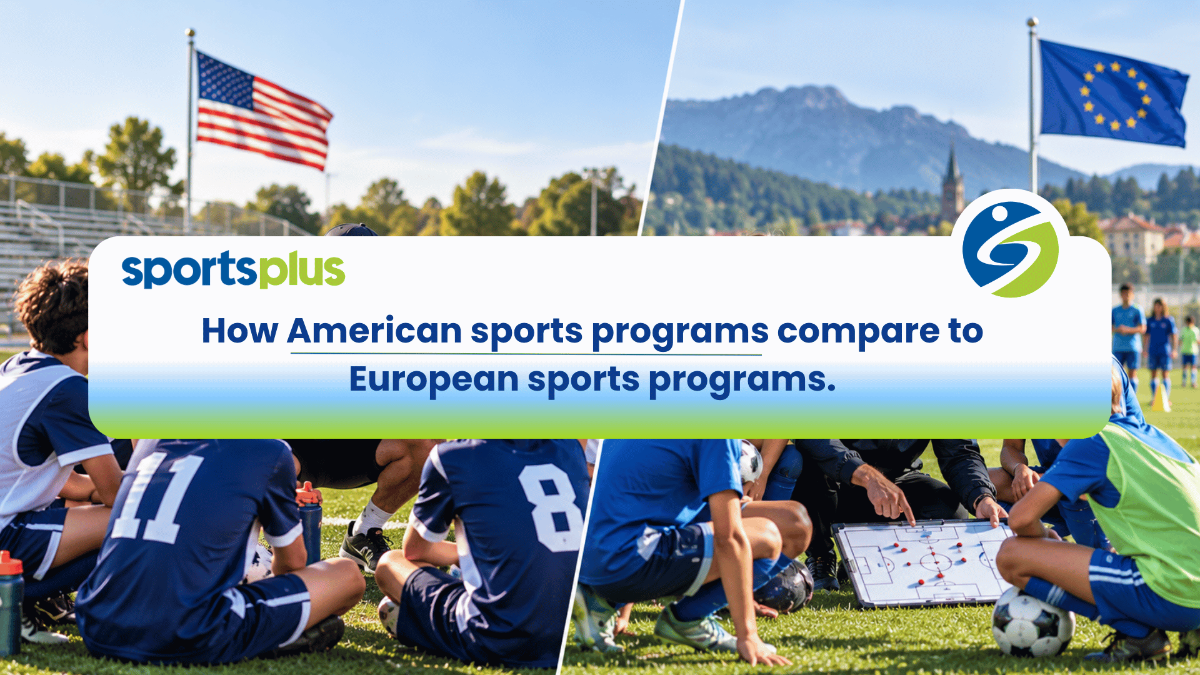
American athletic programs are largely structured around K-12 and higher education institutions, with private clubs serving as supplementary funding sources and families shouldering the bulk of the financial burden. Schools have a secondary role in European sports programs, which are structured around professional academies and community groups. Specialization usually begins earlier, particularly in soccer, and schools have less of an impact overall. In a nutshell, neither method is superior. Everyone in charge of a club, league, or academy should consider the benefits and drawbacks of each because they were designed to address certain issues.
Everyone from parents to coaches to administrators at the club or league level can use this comparison to better grasp the differences between the two systems and, more importantly, to find out what each one excels at. You will find an analysis of the two models' structure, the science underlying the timing of specialization, the steps athletes take to become professionals in each system, and a framework to compare and contrast your own organization with the two.
Key Takeaways
- The US ties competitive sports to schools and colleges (NCAA, high school athletics). Europe ties them to independent, member-based clubs and professional academies.
- American families typically pay directly for participation, a model often called "pay-to-play." Many European clubs run on modest membership dues, with elite academies funded by professional clubs rather than parents.
- European systems, particularly in soccer, specialize athletes earlier, often by age 9 to 12. American sports culture has traditionally supported multi-sport participation into the teenage years, though that's shifting.
- The NCAA has no real European equivalent. Nowhere in Europe does an athlete combine elite competition with a bachelor's degree the way an American college athlete can.
- Both systems have real weaknesses. Pay-to-play creates access barriers in the US. Academy systems in Europe release the large majority of the young players they sign, long before they reach a professional contract.
- Regardless of which model an organization follows, the day-to-day administrative needs (registration, scheduling, payments, communication) are strikingly similar. They're just built around different fee structures.
Quick Comparison: US vs. European Sports Systems
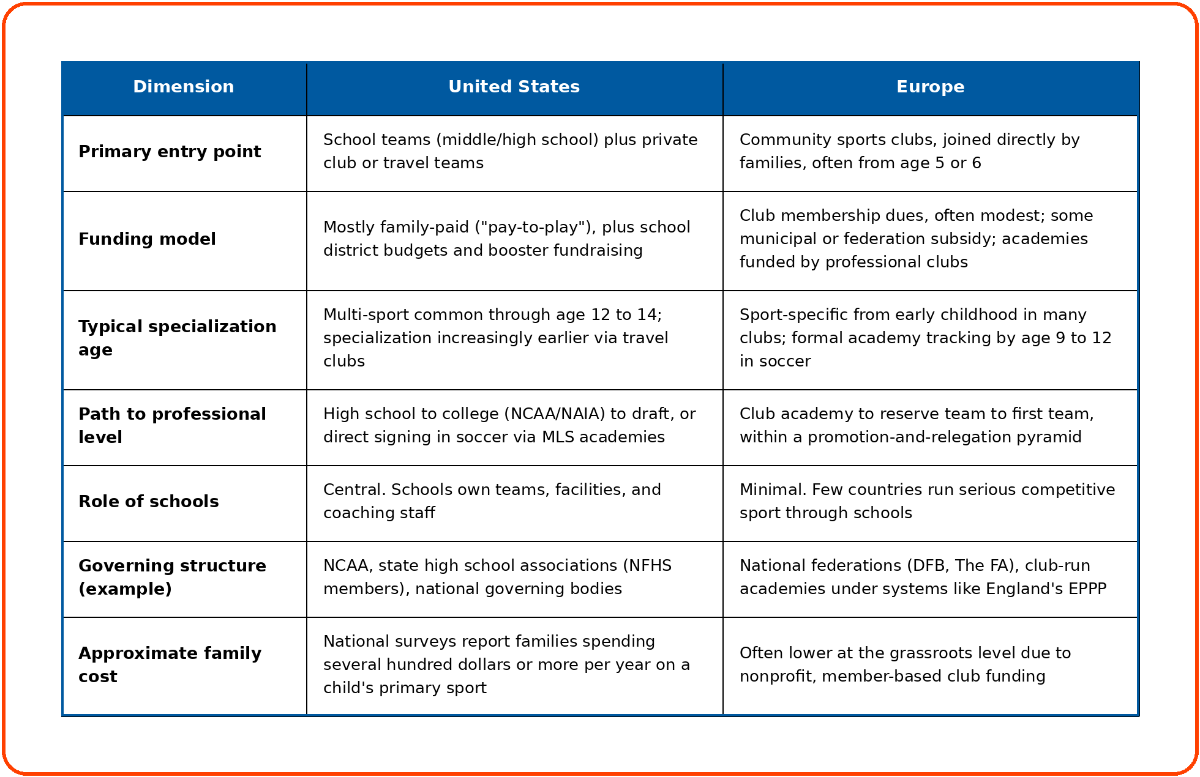
Aside from noting that the systems differ, the summary fails to explain why; thus, the remainder of this article delves into the reasoning behind each row in the table.
How Are Amateur and Youth Sports Organized in the US?
The United States of America incorporates competitive sports into its educational system. At the state level, organizations that are members of the National Federation of State High School Associations (NFHS) oversee the formation of middle school and high school teams. The school district owns the facilities, the coaches are usually teachers or staff members, and enrollment and grades determine who can play.
Alongside that, there is a substantial private layer consisting of non-school-affiliated club and travel teams (such as soccer clubs, AAU basketball, club volleyball, and select baseball). For sports where playing at a high school level isn't enough to get into prestigious colleges or on the pro track, these programs offer better coaching, training all year round, and exposure to college recruiters.
Along with minor regulatory bodies such as the NJCAA and NAIA, the NCAA sits atop the amateur pyramid. With over half a million student-athletes taking part each year, collegiate athletics are under the watchful eye of the National Collegiate Athletic Association (NCAA). The majority of American sports, with the exception of soccer, use a college draft as their entry point for promising high school athletes. For all the reasons stated above, this is the most fundamental dissimilarity between the NCAA and its European counterpart.
How Does Europe's System for Youth and Amateur Sports Work?
Community clubs, rather than schools, are the primary organizers of organized sports in most of Europe. Around the age of five or six, children in Scandinavia, the Netherlands, and Germany often join a local club that fields both recreational and competitive teams for adults. This is codified in Germany's "Verein" system, which refers to non-profit, member-run groups that are not affiliated with any particular school. Clubs, not schools, play a much larger role in German athletic culture; the DOSB counts tens of thousands of clubs across the country with memberships in the tens of millions.
The best teams have their own academies where players can work toward professional and competitive careers. This is codified in England through the 2012 Premier League Elite Player Performance Plan (EPPP), which ranks academies according to the resources they provide in terms of coaching, education, and infrastructure. Talented kids can be signed to an academy by a professional team before they even reach puberty. Starting with an age-group team, one can work their way up to the first team, reserve team, or "B" team - all within the same club.
The system of promotion and relegation serves to strengthen this. All the way up the pyramid, even the smallest clubs have a reason to compete, and a way to sell their potential, to the bigger clubs. In contrast, most European countries do not field serious competitive teams for schools. There is a marked divide between the educational system and the sporting one.
Who Pays for Youth Sports in Each System?
In the United States, families carry most of the direct cost. This is commonly called "pay-to-play." National survey data from the Aspen Institute's Project Play initiative has repeatedly found that American families spend meaningful money annually on a child's primary sport, a figure that climbs sharply once travel and select-level club fees are involved. School sports aren't always free either; some districts charge participation fees on top of transportation and equipment costs.
In Europe, the base layer of the system looks different. Community clubs are typically nonprofit membership organizations, and annual dues at the grassroots level are often modest compared to American club sports fees. Some countries provide municipal facility support or federation-level subsidies that help keep grassroots costs down. At the elite end, academy training is funded by the professional club itself, not by the player's family, because the club is investing in a potential future asset (a player it can develop and eventually sell or promote to the first team).
This doesn't mean European sport is free or perfectly equitable. Elite travel, private coaching, and academy-adjacent training can still be costly. But the baseline entry point into organized sport tends to be more affordable in the European club model than in the American club and travel-team layer.
When do American and European athletes begin to specialize?
Historically, American sports culture has promoted participation in multiple sports throughout adolescence. It isnot uncommonfor a gifted 12-year-old toparticipatein three different sports during the school year: soccer in the fall, basketball in the winter, and baseball in the spring. Specialization is often encouraged at a younger age in European sports, especially soccer. When a kid is 8 or 9 years old, ifthey're deemedtalented, they can start training for a single sport many times a week through a club's young academy pathway.
Beyond tradition, this distinction is significant. There is a higher risk of overuse injuries and burnout if young athletes specialize in just one sport at a young age, according to recommendations issued by the American Academy of Pediatrics. Young athletes who began to specialize at a younger age were more likely to sustain injuries than their peers who participated in a variety of sports, according to research published in Sports Health (Jayanthi et al.).
Keep in mind that this isn't a simple good guys/bad guys tale centered around the United States. Research from the Aspen Institute has shown that competitive travel team culture and college recruitment pressure are pushing American youth sports, especially outside of soccer, toward earlier specialization. This trend is concerning. The two systems are beginning to converge, but they are approaching it from opposite directions.
In Which System Can a Athlete Advance to the Professional or Elite Level?
College is the most common route in the United States (apart from soccer). A collegiate athlete who excels in high school typically obtains a seat on the team and a scholarship, plays for several years under NCAA or NAIA regulations, and then enters the professional draft. This is particularly true in the male-dominated sports of football, basketball, and baseball, as well as in the female-dominated sports of softball, volleyball, and others, an arena profoundly impacted by Title IX, the federal statute enacted in 1972 mandating gender parity in school athletic programs.
The most common route in Europe is via club academies. Without necessarily tying it to their academic pursuits, a club may enroll a kid in its academy system, nurture them through age-group teams, and then promote them to the reserve or first squad if they prove to be good enough. Clubs at all levels of the pyramid have a financial incentive to invest in youth development thanks to promotion and relegation, which allows even minor clubs to produce players and sell them to bigger ones.
American soccer is a rare case that proves the norm. U.S. Soccer and Major League Soccer modeled their academy system after Europe's after seeing an influx of talented young players forego four-year universities in favor of professional contracts abroad or with MLS clubs directly. Clubs can now sign academy graduates directly to professional contracts through MLS NEXT (which took over from the US Soccer Development Academy after it closed in 2020) and MLS's Homegrown Player Rule, bypassing the need for a college stop. The fact that not every sport thinks that playing collegiate sports is the best option is evident even within the American system.
Which System Produces Better Athletes?
There isn't a single correct answer, and any article claiming otherwise is oversimplifying. It depends heavily on the sport and what "better" means.
The American system's strength is scale and infrastructure. Few countries can match the facilities, coaching depth, and competitive volume available through US college athletics, particularly for football, basketball, baseball, and women's sports broadly, where Title IX created a funding mandate with no real European parallel.
The European system's strength is early technical development, especially in soccer. Starting structured, professional-level coaching at age 8 or 9, inside a club with a direct financial interest in developing talent, tends to produce more technically refined players earlier than a system where the same child might not get serious position-specific coaching until high school.
The honest conclusion: American depth and European technical development are answers to different questions. A club or federation trying to copy the other system wholesale, without addressing the underlying funding and governance structure that makes it work, usually ends up with the downsides of both.
What Can American Sports Organizations Learn From the European Club Model?
- Build for continuity, not just seasons. European clubs often serve the same family across decades, from a child's first season through adult recreational leagues. American clubs and leagues built purely around a single season or age group tend to lose families once a child ages out or a season ends.
- Lower the entry cost at the grassroots level. Not every program needs to charge travel-team prices. A tiered structure, recreational access at low cost, competitive access at higher cost, mirrors how European clubs keep participation broad while still funding elite development.
- Treat player development as a pathway, not a series of unconnected teams. European academies track a player's progress through the club over years. American clubs that create a visible internal pathway (recreational to select to elite) tend to retain both players and coaching consistency.
What Can European Sports Organizations Learn From the American School/College Model?
- Invest in facilities as a shared community asset. American high schools and colleges have built sports infrastructure (fields, weight rooms, athletic training staff) that many European clubs, particularly smaller ones, don't have access to.
- Combine athletics and education deliberately. The NCAA model, whatever its flaws, keeps athletes engaged academically while competing at a high level. Some European academies have faced criticism for under-prioritizing education for young players who are ultimately released and don't turn professional.
- Use structured, funded pathways for women's sports. Title IX forced a level of institutional investment in women's athletics that doesn't have a direct equivalent in most European school or club systems. The growth of women's basketball, soccer, and volleyball in the US college system is a direct result of that policy.
Common Mistakes Organizations Make When Borrowing From the "Other" Model
Organizations often try to copy a surface-level feature of the other system without the structure that supports it. A few recurring mistakes:
- Adding early specialization without academy-level coaching depth. Pushing a 9-year-old into single-sport training only works if the coaching quality matches what a funded academy provides. Without it, you get the injury and burnout risk without the developmental benefit.
- Copying low membership fees without a funding source to replace them. European clubs can charge modest dues because of nonprofit structures, municipal support, or academy revenue elsewhere. A US club that slashes fees without another funding source usually can't sustain facilities or coaching quality.
- Building a "pathway" that exists on paper but not in practice. Plenty of organizations claim a recreational-to-elite pipeline. Few actually track and communicate it clearly enough for families to see it.
What This Denotes for Present-Day Club and League Managers
Someone has to handle registration, collect payments, create schedules for different age groups and teams, and keep coaches and parents informed, regardless of the model an organization chooses or how it combines the two. The form that the work takes is different. The payment logic required by a club that collects recurring annual membership dues (common in Europe) and one that charges seasonal, pay-to-play fees (common in the US) are different. Community clubs that host more than one team and cater to members of all ages require organizational-wide scheduling and communication solutions.
A service like SportsPlus is useful in this regard. No matter what kind of funding model or development philosophy your sports organization follows, our platform can handle all of your registration and payment needs, as well as your scheduling, team and league management, and communication. Although the fee logic of a travel club with seasonal pay-to-play fees and a club that embraces a more multi-generational membership model are different, the underlying system must be able to manage registration, collect payments reliably, and centralize scheduling and communication for all age groups.
A Framework for Evaluating Your Own Club Against Both Models
Use these questions as a starting point, whether you're building a new organization or reassessing an existing one:
- Is your funding model sustainable and accessible? If you rely entirely on pay-to-play fees, what happens to families who can't afford them? Is there a lower-cost recreational tier?
- At what age are you encouraging specialization, and is that intentional? If players are specializing early, do you have the coaching depth to justify it, or is it happening by accident through travel team pressure?
- Is there a visible pathway within your organization? Can a recreational player see a realistic route to a more competitive team within your club, or do players have to leave to advance?
- Are your administrative systems built for how you actually operate? A club with recurring membership dues, multiple age groups, and shared facilities needs different registration and scheduling logic than a single-season travel team.
- Are you creating a club identity that outlasts one season? Families who feel connected to a club (not just a single team or coach) are more likely to stay through multiple seasons and refer others.
Final Takeaway
Despite sharing a common goal - the development of athletes and the creation of communities centered around sport - the organizational frameworks of American and European sports programs are radically different. The US expects families to pay for most of the competition out of their own pockets and ties it to schools and universities. Europe expects the club system to finance development through dues, subsidies, and investment in professional academies, while tying competitiveness to independent clubs. Both models have their advantages and disadvantages, and the most effective companies learn from both but use different parts of each instead of trying to replicate the other system word for word.
This has important practical implications for those in charge of clubs and leagues: the quality of your organization's management is more important than the philosophical paradigm you pick. That includes making sure the registration, payment, scheduling, and communication systems are designed to work in tandem with how your organization handles financial transactions and progresses players through the program.
Check out how SportsPlus can help your club or league manage registration, payments, scheduling, and communication no matter what model you're using if you're assessing the structure of your organization and want the administrative side to stay up to date.
Frequently Asked Questions
Does Europe have school sports teams like the US?
Rarely at a competitive level. Most European countries organize youth sport through independent community clubs rather than schools. Some intramural or regional school competitions exist in certain countries, but they don't carry the same weight, funding, or cultural importance as American high school and college athletics.
Why is youth sports so expensive in the US?
Because most competitive youth sport outside of basic school teams runs through privately funded club and travel programs, and families cover most of the cost directly. National survey data from the Aspen Institute's Project Play has documented this "pay-to-play" pattern and its impact on family spending.
What is the European club system called?
In Germany it's known as the "Verein" system: nonprofit, member-based clubs that serve all ages, from children's teams to adult recreational and competitive squads. Similar member-club structures exist across much of Western and Northern Europe, though names and specifics vary by country.
Is the NCAA unique to the United States?
Yes. There is no European equivalent that combines elite-level competition with a bachelor's degree the way the NCAA does. In most European countries, higher education and elite sport are handled through entirely separate systems.
At what age do European soccer academies start recruiting players?
Formal academy tracking often begins around age 9 to 12, though informal club participation typically starts much earlier, around age 5 or 6, at the community level before any academy scouting happens.
Do most academy players in Europe become professionals?
No. The large majority of young players signed into professional club academies are released before reaching a first-team contract. Academy systems function more like a wide funnel than a guaranteed pathway.
Is early sports specialization bad for kids?
Research, including guidance from the American Academy of Pediatrics and studies published in Sports Health, associates early single-sport specialization with a higher risk of overuse injury and burnout compared to multi-sport participation, particularly before adolescence.
Why don't American pro leagues run youth academies like European clubs?
Historically, American pro leagues (NFL, NBA, MLB, NHL) have relied on the college system to develop and showcase talent instead of running their own youth academies. Soccer is the exception: MLS has built an academy system (MLS NEXT) closer to the European model because top young talent increasingly turns professional before college age.
What can a small American club actually copy from the European model?
The most transferable ideas are structural, not financial: building a visible multi-age pathway within one club, keeping recreational-tier costs low relative to elite-tier costs, and designing the club to retain families across seasons rather than just for one team or one year.
How does Title IX affect the comparison between US and European sports?
Title IX, a 1972 US federal law, requires gender equity in school athletic programs and has driven major investment in women's college sports. Most European countries don't have a direct equivalent tied to their club-based system, which is part of why women's sports investment and visibility differ between the two regions.
Which system is better for a child who wants to play professionally one day?
It depends heavily on the sport. For American football, basketball, and baseball, the college pathway remains the standard route. For soccer, and increasingly other sports globally, an academy-style pathway that emphasizes early technical development may be more aligned with how professional recruitment actually works.
Does SportsPlus work for clubs following a European-style membership model?
SportsPlus is built to support registration, payments, scheduling, and communication for a range of organizational structures, including clubs that use recurring membership dues as well as those using seasonal, pay-to-play fee models.

Nathan Uppara
Digital Marketing Lead at SportsPlus
Nathan Uppara is the Digital Marketing Lead at SportsPlus, where he helps sports organizations discover better ways to manage registration, payments, scheduling, communication, websites, and mobile apps. He combines his experience in digital marketing and sports technology to create practical content and resources for clubs, leagues, and sports organizations.
Latest in Sports Admins
What Features Should a Youth Sports Club Website Have in 2026?
Oct 9, 202642
What Should a Modern Sports Organization Website Actually Do?
Oct 2, 202662
Why Generic Website Builders Dont Work for Sports Organizations
Sep 18, 202666
Smarter Sports Management with AI-Powered Features in SportsPlus
Jan 7, 2026184
Game Over on Booking Chaos-Sports Facility Software That Scores
Nov 19, 2025249
Popular in Sports Admins

Top 6 Golf Online Stores
Dec 14, 202310923
Top 5 Tennis Online Stores
Dec 14, 20239062
The All-in-One Playbook for Stress-Free Sports Fundraising
Dec 13, 20232184
Top 10 Sports Website Builders Compared (Why Most Will Cost You Registrations)
Jun 18, 20241566
Player Stats-Importance,Popularity,Usage
Dec 15, 20231432