
Why Generic Website Builders Dont Work for Sports Organizations

Generic website builders such as Wix, Squarespace, WordPress, and GoDaddy have made it easier than ever for organizations to create a website. You can choose a template, add your logo and branding, create pages, publish information, and manage your website without needing to be a developer. For many businesses and organizations, that approach works perfectly well. A website is often treated as a digital brochure where the main information changes occasionally and the primary goal is to establish an online presence.
Sports organizations operate differently. A sports club, league, academy, or tournament organization is constantly dealing with information that changes throughout the season. Games move because of weather or facility availability. Teams change. Players register. Rosters are updated. Programs open and close. Practice times change. Tournament brackets move forward. Results are recorded. Standings change. New seasons begin while information from the previous season still exists somewhere on the website.
The problem is not necessarily that generic website builders are bad products. The problem is that they are general-purpose tools being used to manage an organization whose information is highly dynamic and interconnected. A generic website builder understands pages, sections, images, forms, and text. A sports organization works with teams, seasons, divisions, players, schedules, venues, programs, registrations, tournaments, and results. When those two models don't naturally connect, someone has to fill the gap.
That someone is often a volunteer.
At launch, a sports website can look excellent. The pages are polished, the branding is in place, the programs are listed, and the organization finally has a professional digital presence. But the real test doesn't happen on launch day. It happens several weeks into the season when schedules begin changing, players move between teams, programs reach capacity, and tournament information needs to be updated. A website that requires someone to manually keep every piece of information synchronized can quickly become difficult to maintain.
For club administrators, league commissioners, tournament directors, coaches, and volunteer boards, the important question is therefore not simply, “Can we build a website?” The more important question is, “Can our website keep up with the way our organization actually operates?”
What Is the Difference Between a Generic Website Builder and a Sports-First Website Builder?
A generic website builder is primarily designed around creating and managing pages. You create a page, add text, images, buttons, forms, videos, and other elements, and publish that content for visitors. If something changes, someone goes back into the website and edits the relevant content. This model works well when the information is relatively stable and when the website is primarily being used to communicate information about an organization.
A sports-first website builder approaches the website from a different starting point. Instead of thinking only about pages, it considers the operational information that a sports organization needs to manage every day. Schedules, rosters, registrations, teams, programs, standings, tournaments, results, seasons, and facilities are not simply pieces of text. They are connected data that changes as the organization operates.
Consider a schedule. On a generic website, a schedule might be created as a table, uploaded as a document, embedded from another calendar, or manually added to a page. The website can display the schedule, but it may not understand the relationship between that game, the teams involved, the division, the season, the venue, and the result. If something changes, someone may have to update the website separately from the system actually managing the schedule.
A sports-first website builder is designed to reduce that separation. The website can be connected to the sports management platform where the organization's operational information already exists. Instead of recreating information for the website, the website becomes another way of presenting the organization's existing data.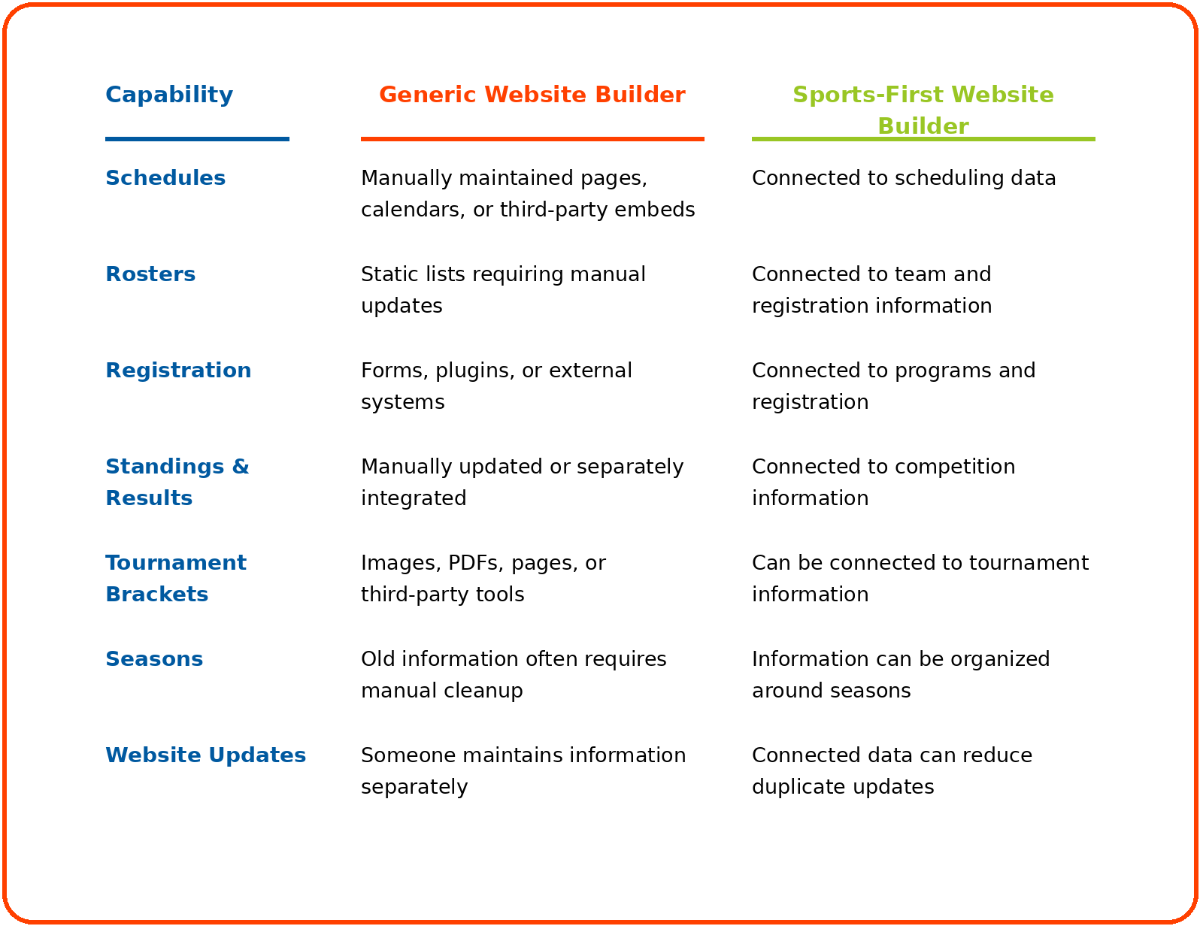
The distinction is therefore not simply about design or the number of templates available. It is about where the website gets its information and how much manual work is required to keep that information current. A generic builder can certainly display sports information, but displaying information and managing connected sports data are two different things.
A general-purpose platform may be perfectly capable of showing a schedule. The question is what happens when that schedule changes. If someone has to manually update five different pages, the website is creating work around information that already exists somewhere else. A sports-first approach aims to make the operational system the source of truth and allow the website to reflect it.
That difference becomes more important as an organization grows. A small club with a few teams may be able to manage its website manually without much difficulty. A larger organization with multiple seasons, divisions, teams, programs, tournaments, and facilities has far more information moving through the system. At that point, the website needs to become part of the organization's workflow rather than another disconnected destination.
Why Do Sports Club Websites Go Out of Date So Fast?
Sports club websites can go out of date quickly because the information they contain is constantly changing. A business website might go several weeks without requiring an important update. A sports website can become outdated because of a single decision made that morning. A field becomes unavailable, a game is postponed, a registration program fills up, or a team is moved to another division, and suddenly the information on the website needs to change.
The problem becomes more complicated because sports information often appears in multiple locations. A game might appear on the main schedule, the division page, a team page, a calendar, and an upcoming-events section on the homepage. If the game moves, every location containing that information needs to be checked. The website administrator is then responsible for remembering where the information exists and making sure every version says the same thing.
This may not seem like a significant problem when there is only one change. Sports organizations, however, don't experience one change. They experience dozens or hundreds of changes throughout a season. Weather delays, facility conflicts, player changes, registration updates, tournament results, schedule adjustments, and new programs all create additional maintenance requirements.
The result is a website that slowly becomes dependent on human memory and availability. The organization may have the correct information inside its scheduling or registration system, but the website can still show something different because nobody has manually transferred the latest update.
This is why many sports websites look accurate when they launch but become increasingly difficult to maintain over time. The issue isn't necessarily that the people responsible for the website are not doing their jobs. It is that the website requires them to repeatedly recreate information that already exists somewhere else.
The Update Chain: One Change, Many Places
Consider a simple example. A Saturday U12 game is scheduled for 9:00 a.m. on Field 3. On Friday afternoon, the facility informs the club that Field 3 is unavailable because of maintenance. The game is moved to Field 5 at 11:00 a.m. The change itself is straightforward. The game has a new time and a new location.
On a manually maintained website, however, that one operational change may need to be reflected in several places. The league-wide schedule may need to be updated. The U12 division page may need to be checked. The two team pages involved may display the game. The website calendar may need to be changed. The homepage may have an upcoming-games section or announcement that also needs to be reviewed.
One change has now become multiple website tasks.
This is the Update Chain. When the same piece of information is manually maintained in several places, every change creates a chain of updates that someone needs to complete. The more places that information appears, the greater the chance that one of them will be missed.
The consequences can be very real. The schedule may show 11:00 a.m. while an old team page still says 9:00 a.m. One page may show Field 5 while another still says Field 3. A parent checks the wrong page, follows outdated information, and arrives at the wrong location.
The website has not failed because it couldn't display a schedule. It has failed because the schedule was disconnected from the system that actually manages the game.
Now multiply that example across an entire season. Games move because of weather. Facilities change. Referees become unavailable. Teams are rescheduled. Tournament games are adjusted. Each change adds another potential update chain.
A connected sports platform approaches the same situation differently. The schedule can be changed in the system where the organization manages its games, and the connected website can reflect the updated information. Instead of updating the same information repeatedly, the goal becomes simple: update it once and publish it wherever that information is displayed.
When Volunteers Become the Sync Engine
Most sports organizations don't have a dedicated webmaster. Instead, they often have someone who has taken responsibility for the website because they are comfortable with technology. It might be a parent, coach, administrator, board member, or volunteer who originally agreed to handle a few simple website updates. At first, the responsibility doesn't seem particularly difficult. The person may only need to update the homepage, add a new program, upload a few photos, or change some contact information. But once the season begins, that small responsibility can quickly turn into a much larger operational task.
Once the season gets underway, the same person may suddenly be expected to maintain schedules, team pages, registration information, announcements, tournament details, and other content that changes throughout the season. At the same time, the organization may be using separate systems for registration, scheduling, payments, communication, team management, and other operations. Information is created in one system and then has to be copied or recreated somewhere else so that the website remains current. The volunteer effectively becomes the connection between all of these systems, even though maintaining that connection was never really supposed to be their job.
This is one of the biggest hidden problems with maintaining a sports website on a general-purpose platform. The website itself may not be expensive, but keeping it accurate depends heavily on someone's time and attention. Volunteer time is limited, especially during the busiest parts of a season when the same people are already dealing with registrations, schedules, games, facilities, communication, and day-to-day club operations. Every additional website update adds another small task to an already long list.
The problem becomes even more visible when the person responsible for the website becomes unavailable. If that person steps away, moves on, or simply no longer has the time to manage the site, the organization may discover that nobody else knows exactly how the website works or where all of the information comes from. Over time, old programs remain online, previous-season information stays visible, team pages become outdated, and schedules stop being maintained. The organization itself hasn't stopped operating. The website has simply stopped keeping up with it.
This is why reducing manual synchronization matters. A better system shouldn't require volunteers to act as the permanent connection between registration, scheduling, team management, communication, and the website. Their time should be spent running the organization, supporting players and families, managing programs, and delivering the sporting experience rather than repeatedly copying information between systems.
What Sports-Specific Information Is Difficult to Maintain on Generic Websites?
The underlying issue with sports information is that it is structured and relational. A roster isn't simply a list of names. It belongs to a team. That team belongs to a division. The division belongs to a season. A game belongs to a schedule and involves specific teams, a venue, a date, and a time. A result can affect standings, and the result of one tournament game can determine what happens in the next round.
Generic website builders are excellent at displaying information, but they aren't necessarily designed around those relationships. When the website doesn't understand those relationships, organizations often have to recreate them manually through pages, tables, forms, documents, embedded calendars, and third-party tools.
That can be manageable for a small organization. But as the number of teams, programs, games, and competitions increases, the amount of manual work increases with it. The website becomes harder to maintain not because any individual update is particularly complicated, but because there are so many updates and so many relationships to keep track of.
Schedules
Schedules are among the most frequently changing pieces of information on a sports website. A club may have hundreds of games and practices spread across multiple teams, divisions, venues, and seasons. Families may want to view schedules by team or date, while administrators may need to manage the entire organization.
On a generic website, that information may exist as a manually maintained table, an embedded calendar, a spreadsheet, or a third-party widget. These approaches can display schedules, but the schedule may still exist separately from the system actually managing the organization's games.
When a game changes, someone has to make sure the website reflects that change. If the same game appears in multiple locations, each location needs to be checked. The website administrator is effectively maintaining a second version of the schedule.
A sports-first website can instead connect the public schedule to the organization's scheduling data. The schedule is managed where the organization manages its games, while the website presents that information to families and visitors. This reduces duplicate entry and makes the website more closely reflect what is actually happening within the organization.
Rosters and Team Pages
Rosters change throughout the season. Players register, teams are formed, players move between teams, new players join, and coaches can change. On a manually maintained website, every roster change can become another website update.
This becomes especially difficult for organizations with a large number of teams. If every team page contains a manually typed list of players, administrators have to remember to update those pages whenever registration information changes. Over time, the website roster can become different from the roster the organization actually manages.
Connecting team pages with registration and team information creates a different workflow. Instead of manually recreating the roster as website content, the website can use the organization's existing team data. The objective is straightforward: when the organization's team information is current, the website should have a way to reflect that information.
Programs and Registration
Programs and registration are another area where disconnected websites can create problems. A parent may visit a club website looking for a spring soccer program, summer camp, basketball league, or another activity. They find the program, click the registration button, and are taken to a separate registration system.
Using a separate registration system isn't necessarily a problem. The issue is what happens when the information in the two systems becomes different. A program may reach capacity while the website still presents it as available. Registration may close while an old page continues to appear in search results. Program dates or eligibility requirements may change, but the website can still show the original information.
When website and registration information are connected, the public website can more accurately reflect the organization's current programs. Visitors can find the information they need while administrators spend less time manually keeping multiple versions of the same information aligned.
Registration is particularly important because it represents the point where interest becomes action. A prospective family may discover a club through search, visit the website, learn about a program, and decide to register. The more disconnected that journey becomes, the more opportunities there are for confusion or unnecessary friction.
Tournaments, Brackets and Standings
Tournaments can expose the limitations of manually maintained websites even more quickly. A tournament can produce a large amount of information in a very short period. Games are completed, results are recorded, teams advance, brackets change, and new games are scheduled throughout the event.
Families and visiting teams may check the website repeatedly between games because they need current information. On a generic platform, tournament directors may rely on uploading bracket images, PDFs, screenshots, or manually edited pages after each round.
Those methods can work, but they introduce additional work at exactly the time when tournament staff are already busy running the event. There is also a delay between what happens on the field and what appears online.
A sports-first approach can connect competition information more closely with the website. When results are recorded within the sports platform, the public-facing experience can reflect those results and the resulting changes to the competition. The website becomes part of the tournament information system instead of simply being a place where someone uploads the latest version of a bracket.
How Does a Generic Website Hurt the Parent Experience?
Parents typically don't visit a sports website because they want to explore every page. They visit because they need an answer. They want to know when the next game is, where it is being played, whether practice has changed, whether registration is open, or whether an important announcement has been made.
These questions are simple, but they become frustrating when the website doesn't provide reliable answers. When parents can't find what they need, they naturally look somewhere else. They text the coach, message the team manager, search through a group chat, contact the club, or ask another parent.
That creates a hidden communication burden for the organization. Every piece of information that the website fails to provide becomes another question that someone inside the organization has to answer. Coaches end up responding to questions about game times. Administrators repeat registration details. Volunteers explain policies that could have been clearly published on the website.
Over time, the club's real information system can become a combination of website pages, email threads, spreadsheets, messaging groups, and individual conversations. The website technically exists, but families don't necessarily trust it as their first source of information because they have learned that the latest information may be somewhere else.
There is also a first-impression cost. For a prospective family discovering a sports organization, the website is often one of the first interactions they have with the club. They may be comparing local programs, looking for registration information, trying to understand the organization's structure, or deciding whether it is the right fit for their child. An outdated schedule, broken registration link, or confusing website can create uncertainty before they ever speak to someone at the club.
A good sports website shouldn't replace communication between coaches, administrators, players, and parents. It should make the basic information easier to access so that those conversations can focus on the things that actually require human interaction.
Why Mobile Performance Matters for Sports Websites
Sports websites are often accessed in real-world situations rather than from a desk. Parents check schedules before leaving for practice, players look up game information while travelling, coaches check updates between activities, and visitors search for tournament or facility information while on the way to an event.
That makes mobile usability particularly important for sports organizations. A website can technically be responsive and still be difficult to use. A large schedule table that looks fine on a desktop can become difficult to navigate on a phone. A registration form can become frustrating when it requires excessive scrolling. Important information can be buried several levels deep in the navigation.
The real test isn't simply whether a website loads on a phone. The test is whether someone can quickly accomplish what they came to the website to do. Can a parent find Saturday's game? Can they find the venue? Can they locate registration? Can they find the information for their child's team without having to pinch, zoom, scroll, and search through several pages?
Sports organizations should test their websites in the same environments where their audiences use them. Open the website on a phone and use cellular data. Try finding this week's schedule. Look for a particular team. Find the registration page. Locate the facility information. If these basic tasks take too long, the website is creating friction.
A modern sports website therefore needs to consider mobile experience from the beginning. Information should be easy to scan, navigation should be simple, important actions should be easy to access, and pages should load efficiently. The objective isn't simply to make a desktop website shrink down to fit a phone. It is to create an experience that works naturally on the devices sports families actually use.
The Real Cost of a “Cheap” Generic Website
The monthly website subscription is only one part of the cost of maintaining a website. A platform may appear inexpensive when compared with specialized software, but the organization also needs to consider the time required to keep the website accurate and the additional tools required to support its operations.
The first cost is volunteer and staff time. Someone needs to update schedules, change program information, add announcements, maintain team pages, update registration information, and remove outdated content. The more active the organization, the more frequently these tasks appear. Even small updates can become a significant responsibility when they happen throughout an entire season.
The second cost is tool sprawl. A generic website rarely operates completely on its own. An organization may use one system for registration, another for payments, another for scheduling, another for email, another for communication, and another for tournaments or events. Multiple tools can be useful, but when those tools don't communicate with one another, someone has to manually move information between them.
The third cost is outdated information. An incorrect game time, old program, expired registration page, or outdated team page isn't simply a content problem. It can cause confusion for families and create additional work for administrators who then have to correct the information through direct messages and emails.
The fourth cost is repeated communication. When people can't find reliable information on the website, they ask someone. A question that could have been answered by a good website becomes another message for a coach, administrator, or volunteer.
The fifth cost is credibility. A sports organization may be judged by the experience it provides online before a prospective family ever attends a practice. The website is part of that experience. Design matters, but accuracy, usability, speed, mobile experience, and current information matter as well.
The real cost of a website is therefore not simply the subscription price. Organizations should consider the people, tools, time, and processes required to keep the website useful throughout the entire season.
When Is a Generic Website Builder Actually Fine?
A generic website builder isn't automatically the wrong choice for every sports organization. There are organizations for which a general-purpose website is completely appropriate. If the website is primarily a brochure and contains information that doesn't change frequently, a generic platform can be a practical solution.
For example, a small sports organization may only need an About page, contact information, coach profiles, basic program information, photos, and occasional announcements. If the organization doesn't need complex schedules, rosters, registrations, tournaments, or standings, there may be little reason to introduce a more specialized system.
The situation changes as the organization becomes more operationally complex. A club with multiple teams, divisions, seasons, programs, registrations, facilities, and tournaments has very different requirements from a small group with one fixed weekly activity.
The important question isn't whether a generic website builder can display sports information. It can. The question is how that information is maintained and how much work is required to keep it accurate.
A useful way to think about the decision is to ask what happens after the website has been running for several months. Who updates the schedule? Who changes the rosters? Who removes old programs? Who updates tournament information? Who checks that registration links still work? And what happens when the person doing all of that work is no longer available?
If the answers depend heavily on one volunteer manually maintaining several disconnected systems, the organization may have outgrown the website model it started with.
The Second-Season Test: How to Audit Your Current Club Website
Most websites look good when they launch. The design is fresh, the information is current, and everyone involved is paying attention. The more meaningful test comes later, when the excitement of the launch has passed and the website has to operate through an entire season.
The second season is particularly revealing. New programs need to be added while old programs need to be removed. Teams change. Schedules change. New players register. Previous-season information can remain visible. The person who originally built the website may now have less time to maintain it.
You can evaluate your current website by running five simple tests.
The phone test: Can a parent quickly find this week's schedule on a phone? Don't test this from a desktop. Use the same type of device your families are likely to use while travelling to a game or practice.
The freshness test: Look through your homepage and main navigation. Is there anything referring to a previous season, closed program, former coach, or outdated event? Old information can remain online surprisingly easily when there is no system helping manage it.
The change test: Imagine that a game scheduled for tomorrow suddenly moves to another venue. How many places on your website would need to be changed? More importantly, who would make those changes and how would they know every place that needs to be updated?
The registration test: Start from the homepage as if you were a new family. Can you find an appropriate program, understand who it is for, determine whether registration is open, and complete the registration process without unnecessary friction?
The bus test: Imagine the person currently maintaining the website stepped away tomorrow. Could another person take over the website and keep it current within a reasonable amount of time? Would they know where the information comes from and which systems need to be checked?
These tests aren't meant to criticize the person maintaining the website. In fact, they often reveal how much work that person has been doing behind the scenes. The purpose is to determine whether the website's structure is helping the organization or requiring someone to constantly compensate for limitations in the platform.
If the website only stays current because one person remembers to manually synchronize everything, the problem may not be effort. It may be the tooling.
What Is a Sports-First Website Builder?
A sports-first website builder is designed around the specific information and workflows of sports organizations. Instead of treating the website as an isolated product, it connects the public website more closely with the system managing the organization's operational information.
This distinction matters because the sports management system already contains much of the information the website needs. It knows which teams exist, which players have registered, which programs are available, when games are scheduled, where those games are taking place, and what results have been recorded.
The website can therefore become a public-facing layer of that information rather than another place where everything needs to be recreated.
For example, a schedule can be created within the sports management system and then presented on the website. A registration can add information to the appropriate player and team records. A result can affect standings or tournament information. A program can move from registration-open to registration-closed based on its actual status.
The purpose isn't to eliminate every website edit. Organizations will always need to create announcements, publish stories, add images, update policies, and manage other content. The goal is to eliminate unnecessary duplicate work around information that is already being managed somewhere else.
That changes the role of the website administrator. Instead of being responsible for keeping the website synchronized with the organization, the person can focus on managing the content and digital experience while the connected platform handles more of the underlying sports information.
In simple terms, a sports-first website should help the organization manage the website without requiring the organization to manage the same information twice.
How SportsPlus Approaches Club and League Websites
SportsPlus approaches the website as a connected part of running a sports organization rather than as a completely separate website project. The SportsPlus Website Builder is designed for clubs, leagues, tournaments, and sports organizations that need a professional digital presence while also managing the operational information behind that organization.
The focus isn't only on creating attractive pages. It is also on creating a website that can work alongside the organization's sports operations. Teams, programs, schedules, registration, tournaments, facilities, standings, events, and other information can become part of the overall website experience.
The Website Builder also focuses on sports-first design. Instead of forcing a sports organization to start with a generic business template and then adapt it manually, the website experience can be built around the information sports organizations actually need to present. Organizations can maintain their branding through colors, fonts, logos, headers, footers, and other website elements while using structures designed for sports content.
Another important part of the approach is live data. When information is managed inside SportsPlus, connected website components can reflect that information. The objective is to reduce duplicate entry and avoid making someone manually recreate the same information on multiple website pages. A schedule can be managed within the platform and presented publicly. Team and program information can be connected to the website experience. Competition information can be surfaced as part of the organization's digital presence.
The idea is simple: update once and publish everywhere. Instead of maintaining a separate website version of the organization's operational information, the website can become a way of presenting the information that the organization is already managing.
Mobile experience is another important part of the Website Builder. Sports information is consumed on phones, tablets, and desktops, often in situations where visitors need information quickly. The website experience therefore needs to work naturally across devices and make schedules, programs, registration, teams, and other important information easy to access.
A modern sports website also needs to help visitors get answers. This is where SportsPlus's ClubCaptain AI chatbot becomes part of the website experience. ClubCaptain is designed to provide 24/7 assistance using an organization's public website information. It can help visitors find information related to schedules, programs, policies, documents, game information, and other commonly requested topics.
The purpose of an AI chatbot isn't to replace the people running a sports organization. It is to provide another way for visitors to access information and help reduce some of the repetitive questions that staff and volunteers receive. Instead of making every visitor search through multiple pages for a simple answer, an AI-powered experience can make the information easier to access.
Search visibility is another important consideration. A sports organization needs to be discoverable when families search for programs, teams, leagues, tournaments, or sports organizations in their area. That means the website needs to be structured for traditional search as well as emerging AI-driven discovery experiences.
SEO, AEO, GEO, structured data, sitemaps, local search signals, useful content, and analytics all contribute to creating a website that search engines and AI systems can better understand. A modern sports website therefore needs to be built not only for the people who visit it directly, but also for the systems that help people discover it.
The broader idea is that the website should become a connected part of the organization. It should represent the club professionally, make information easier to access, reduce unnecessary maintenance, support discovery, and provide a better experience for the people who interact with the organization online.
The Future of Sports Organization Websites
The future of sports websites isn't simply about having a more attractive homepage. A modern sports website needs to understand that the organization behind it is constantly changing.
Schedules move. Teams change. Programs open and close. Registrations happen. Results are recorded. Tournaments progress. Facilities change. The website needs to keep pace with all of that information while still providing a fast, simple, and professional experience for visitors.
This is why the next generation of sports websites will increasingly focus on connection. The website should be connected to the systems managing the organization rather than operating as an isolated collection of pages. The more closely those systems work together, the less information needs to be manually recreated.
The experience is also becoming more conversational. Visitors increasingly expect to be able to ask questions rather than search through several pages to find an answer. An AI-powered chatbot can provide another layer of access to public information, helping visitors find relevant details about programs, schedules, policies, teams, and other information.
At the same time, search itself is changing. People are finding organizations through traditional search engines, local results, maps, social platforms, and AI-powered tools. Sports organizations therefore need websites that are structured and optimized for multiple discovery channels.
The modern sports website is becoming a combination of several things: a professional digital presence, a public-facing view of operational information, a registration and discovery channel, a mobile experience, a search-ready resource, an analytics platform, and increasingly an intelligent information assistant.
That is where sports websites are heading.
Sports-first. Mobile-first. Connected. Fast. Discoverable. Intelligent.
Final Takeaway
If your club website is constantly falling out of date, it may not be because your volunteers aren't doing enough. They may already be spending significant time trying to keep the website synchronized with everything happening across the organization.
The bigger issue may be the system they are being asked to maintain.
Generic website builders are useful tools. They make it possible for organizations to create professional websites without requiring a development team, and for simple websites they can be an effective solution. But sports organizations have a different operational challenge because their most important information changes constantly.
Schedules move. Rosters change. Programs open and close. Players register. Results are recorded. Tournaments progress. Venues change. Every one of those changes has the potential to create another website update when the website operates separately from the system managing the organization.
A sports-first website builder takes a different approach by connecting the public website more closely with the organization's operational data. Instead of asking a volunteer to repeatedly recreate information, the website can become a reflection of information that is already being managed inside the sports platform.
That can change what website maintenance looks like. The person managing the website can spend less time copying information between systems and more time focusing on the content, branding, communication, and digital experience of the organization.
The modern sports website also needs to do more than display information. It needs to work on mobile, help visitors discover programs, make registration easier to find, support search visibility, provide useful analytics, and increasingly help visitors get answers through AI-powered experiences.
Your sports organization is constantly moving.
Your website should move with it.
The goal isn't simply to build another sports website.
The goal is to build a website that works the way a modern sports organization works.
Frequently Asked Questions
Can I use Wix or Squarespace for a sports club website?
Yes. Wix, Squarespace, WordPress, and other general-purpose website builders can be used to create sports club websites. They can work well when the website primarily functions as a brochure and contains information that doesn't change frequently. The challenge becomes greater when a club needs to manage schedules, rosters, programs, registrations, standings, tournaments, and other information that changes throughout the season. In those situations, organizations may need additional tools, integrations, and manual processes to keep the website synchronized with their operations.
Why does our club website always seem out of date?
Sports information changes frequently. Games are rescheduled, players join teams, programs open and close, venues change, and tournament information evolves throughout a season. When the website isn't connected to the systems managing that information, someone has to manually update it. If the same information appears in several places, one change can require multiple edits, increasing the chance that something will be missed.
What is a sports-first website builder?
A sports-first website builder is designed around the specific requirements of sports organizations. It can connect website content with operational information such as teams, schedules, programs, registrations, tournaments, and results. Instead of treating every piece of sports information as a separate website page that needs to be manually maintained, the website can use information already managed within the sports platform.
What should a sports club website include?
A sports club website should make the information families, players, coaches, and visitors need easiest to find. This generally includes current schedules, team information, programs, registration, contact details, facilities, announcements, and important club resources. Depending on the organization, it may also include standings, results, tournament brackets, staff information, policies, documents, events, and other resources. The important thing is that the information is current, easy to navigate, and accessible across devices.
Do sports websites really need to be mobile-first?
Mobile experience is particularly important for sports organizations because parents, players, coaches, and visitors frequently access information from phones while travelling to practices, games, tournaments, and facilities. A website can technically work on mobile while still being difficult to use. Schedules should be readable, navigation should be simple, important information should be easy to find, and registration should not require unnecessary steps.
Is WordPress a good option for a sports league?
WordPress is a flexible website platform and can be used to create sports websites. Its flexibility can be useful for organizations with the technical resources to manage hosting, plugins, updates, security, integrations, and ongoing maintenance. The more important question is how the league will manage its sports data. A website platform by itself does not automatically solve the challenge of keeping schedules, rosters, registrations, tournaments, results, and other operational information synchronized.
How much does a sports club website cost?
The website subscription is only one part of the total cost. Organizations should also consider the time required to maintain the website, additional tools for registration and payments, scheduling and calendar systems, integrations, hosting, technical maintenance, and the administrative work involved in keeping information current. A website with a low monthly subscription can still require significant investment if staff or volunteers have to spend hours every week maintaining information across multiple systems.
Can we keep our existing domain name if we switch to a sports platform?
In many cases, organizations can continue using a domain they already own when moving to a new website platform. The exact process depends on the organization's current domain and hosting configuration. The domain can generally be connected to the new website after the required DNS and domain settings have been configured.
How do sports websites update schedules automatically?
On a connected sports platform, the schedule is managed within the same system that powers the website. When a game is created or changed in the sports management system, connected website components can reflect that information without requiring someone to manually recreate the schedule on a separate website. This reduces duplicate data entry and helps keep the public website aligned with the organization's operational information.
What about tournament brackets? Can a normal website show live brackets?
A normal website can display tournament brackets, but the method used to maintain them depends on the platform. Organizations may upload bracket images, PDFs, screenshots, manually update pages, or use third-party tournament tools. A sports-first approach can connect tournament information more closely with competition data. When results are recorded, the public-facing tournament information can reflect the progress of the competition without requiring the tournament director to manually recreate every update on the website.
Will a sports-specific website builder limit our design?
A sports-first website builder can combine sports-specific functionality with design customization. Organizations can maintain their branding through logos, colors, fonts, headers, footers, layouts, and other website elements while using structures designed around sports information. The goal is to avoid choosing between a professional-looking website and a website that actually works with the organization's sports operations.
Our volunteer webmaster just quit. What should we do?
This can be an opportunity to evaluate the website maintenance process itself. If one person is responsible for manually synchronizing schedules, rosters, programs, registrations, and other information, simply replacing that person may recreate the same problem. A sports-first platform can reduce that dependency by connecting the website more closely with the systems already managing the organization's operational information. The goal is to make website maintenance a smaller responsibility rather than requiring one person to act as the organization's manual synchronization layer.

Nathan Uppara
Digital Marketing Lead at SportsPlus
Nathan Uppara is the Digital Marketing Lead at SportsPlus, where he helps sports organizations discover better ways to manage registration, payments, scheduling, communication, websites, and mobile apps. He combines his experience in digital marketing and sports technology to create practical content and resources for clubs, leagues, and sports organizations.
Latest in Sports Admins
What Features Should a Youth Sports Club Website Have in 2026?
Oct 9, 202616
What Should a Modern Sports Organization Website Actually Do?
Oct 2, 202660
Smarter Sports Management with AI-Powered Features in SportsPlus
Jan 7, 2026182
Game Over on Booking Chaos-Sports Facility Software That Scores
Nov 19, 2025243
Streamline Registration Payments and Eliminate Admin Headaches with SportsPlus
Oct 15, 2025273
Popular in Sports Admins

Top 6 Golf Online Stores
Dec 14, 202310913
Top 5 Tennis Online Stores
Dec 14, 20239056
The All-in-One Playbook for Stress-Free Sports Fundraising
Dec 13, 20232182
Top 10 Sports Website Builders Compared (Why Most Will Cost You Registrations)
Jun 18, 20241562
Player Stats-Importance,Popularity,Usage
Dec 15, 20231430